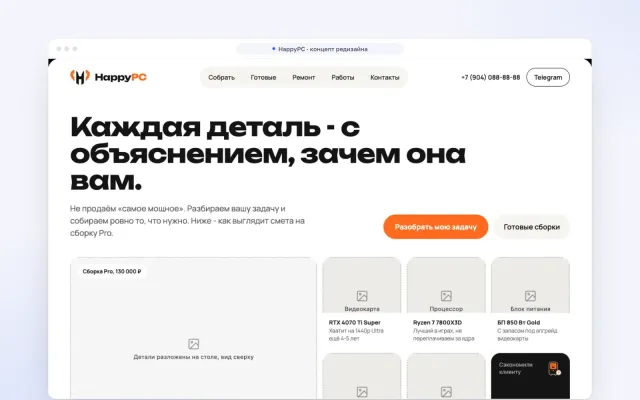
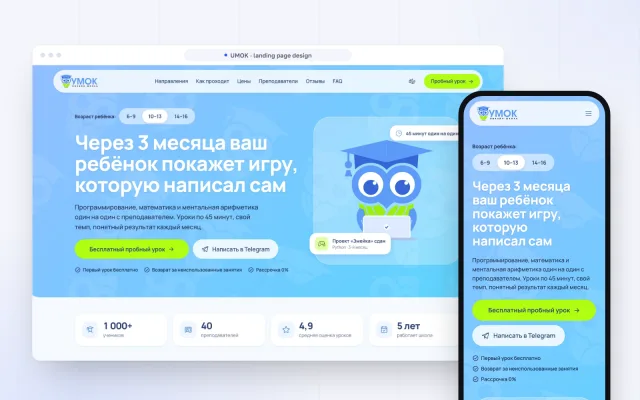
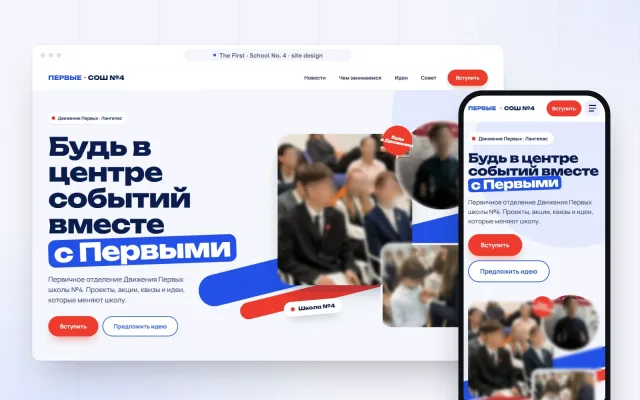
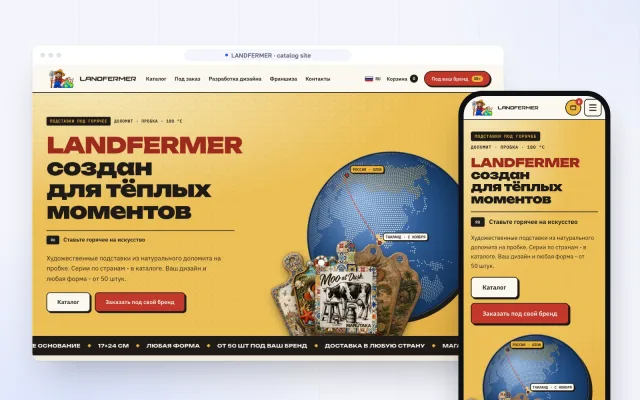



Landing page headline: formulas that bring leads
Someone lands on your page. You have three seconds to make it worth their time. If the headline doesn't look like a relevant solution to their problem, they leave - and you lose the lead. This article breaks down how to write a headline that works and how to tell when yours doesn't.
Why your landing page headline matters more than you think
A landing page isn't a blog post or a corporate site. It has one job: get a contact or a sale. Everything else is noise. The headline above the fold decides whether the visitor reads on or closes the tab.
Eye-tracking studies show people look at the headline first, then the image or video, then the button. If the headline is dull or unclear, they won't even read the subheading. They just landed in the wrong place and they leave.
A good headline does two things at once: it reminds the visitor of their problem and promises a solution. A bad headline talks about the company, its values, or shouts about a discount no one cares about.
Formula one: problem plus solution
The most reliable pattern: name the pain, then say how you remove it. Example for a clothing store: "You spend an hour choosing a shirt - we choose one in 30 seconds" instead of "Welcome to BEST SHOP".
Why it works: the person recognises themselves in the first part and immediately sees that their way out is further down the page. They stay and read because the copy is about their situation.
How to write it: first write down the pain you solve (slow, expensive, complicated, scary). Then how you solve it (fast, cheap, simple, safe). Check it doesn't sound like two separate sentences - they should be one thought.
Formula two: value plus number
Concrete numbers in a headline work better than words. "We'll increase your sales" - everyone's heard that. But "Clients earn +40% without bringing in new customers" - people remember that and click.
A number works if it's honest and doesn't look wild. If you promise +500%, no one believes you. If you say 2-3 weeks, give or take - they believe. If the number has been achieved several times and wasn't invented just for the landing page - even better.
Important: the number should be a result, not a process. Bad: "We'll create 100 pages of content for you". Good: "We'll bring back 10 lost clients a month through WhatsApp messaging". The first version interests no one, in the second the person sees a result.
Formula three: market plus differentiator
Sometimes a headline that says who you work for and how you're different works well. "For photographers tired of turning down clients because they don't have time" - it's a narrow market, but it's targeted.
The differentiator must be real, not just a word. Don't say you're better than everyone - no one believes that. Say you do this specific thing and competitors can't. Or that you charge this amount and others cost more. Or that you start tomorrow and everyone else has a month-long queue.
The key: the reader must understand why you and not someone else. If that moment isn't in the headline, better not launch the landing page yet - rework your strategy.
Mistakes in landing page headlines
First mistake - talking about yourself instead of the reader's problem. "We're a studio with 10 years of experience" - that's for a corporate site. On a landing page it kills conversion. The reader doesn't come to learn about you, they come to solve their task.
Second mistake - abstract words: "innovative", "modern", "comprehensive". They mean nothing. "An innovative solution for business" - anyone could say that about anything. Instead say something concrete: "In two weeks we'll raise your site's search visibility by 30% without manipulation".
Third mistake - a headline that's too long. If it's more than one line on mobile, rewrite it. People scan diagonally, and if the first line didn't grab attention, the second won't help.
Fourth mistake - a headline about a discount when there's no urgency. If you're a freelancer who took on a job five years ago, there's no urgency. A discount headline only works if there's real pressure, otherwise it feels like manipulation.
Fifth mistake - a headline question that answers itself. "Want to earn more?" - well yes, we do, so what? The question should be rhetorical and lead to an answer that sits in the rest of the copy. Better: "Why do your competitors bring in more leads from the same budget?"
How to test whether your landing page headline works
First test: show the headline to another person, then close the landing page and ask what it meant. If they said something close to what you intended - the headline works. If they started guessing - rewrite it.
Second test: look at the analytics. If bounce rate above the fold is over 60%, it means people see the headline and leave. Not necessarily because it's bad - maybe the traffic is wrong. But check the headline first.
Third test: ask people who submitted a lead what hooked them. If no one mentions the headline - maybe it just didn't get in the way, but it didn't attract either. Try a sharper version.
Fourth test: run two versions of the landing page with different headlines in an A/B test. At least a week. The results will be more honest than any office discussion. EFIMOV DEV often helps clients launch A/B tests when developing landing pages - it's a service that pays for itself in the first week.
A practical checklist for your headline
Before you publish the landing page, check yourself against this list. If the answer is yes to every point - the headline is ready to test.
Point one: does the headline talk about the reader's problem, not your company? Two: does the headline contain a concrete promise or result, not general words? Three: if you remove the company name, will people still understand what you offer? Four: does the headline fit on one line on a mobile screen? Five: are you ready to defend in a conversation with a client why this headline and not another?
If something didn't pass - rework it. The headline isn't a supporting design element, it's the foundation of the entire landing page. If it's weak, no one will read further, and beautiful design won't save you.
When it makes sense to rewrite the headline on a landing page
If the landing page has been live for a month but leads are coming in weakly - start with the headline. It's the fastest and cheapest way to see if you failed from the very first frame. You can rewrite a headline in a day.
If you've rewritten the headline several times but nothing changed - the problem is probably not there. Maybe the traffic is wrong, or the button is too modest, or the form asks for too much data. Stop working on the headline and look at everything else.
If you have several landing pages for different products - the headlines must differ. One headline for all is a sign you haven't figured out the target audience for each landing page.
If this is already on your plate, here is how we do it end to end: Landing page development.
Frequently asked
How many words should a landing page headline have?+
3-8 words is the sweet spot. Fewer than three may not be enough information, more than eight is already a string of words, not a headline. A mobile screen fits about 10-12 words, then a line break. If the headline wraps to three lines - rewrite it.
Can you use humour in a landing page headline?+
You can, if it's appropriate for your audience. Humour creates a connection with the reader and is remembered better than a dry format. But be careful: what makes you laugh may not amuse someone on the other side of the country. Test it on your target audience before publishing.
How often should you change a landing page headline?+
If the landing page has been running for months or years and conversion is stable - no need to change it. If metrics are dropping or you've launched a new product - rewrite it. Test variants in parallel with A/B tests, don't change the headline on a live landing page just because, or you'll lose your baseline.
Should you coordinate the headline with a designer?+
Yes. The headline must work with the visuals, not against them. If the copy promises speed but the background is a gloomy palette - they're not helping each other. While writing the headline, discuss with the designer how to place it and what to back it up with.